
Seoul Emergency Medical & Pharmacy Guide
LAST UPDATED: August 2026
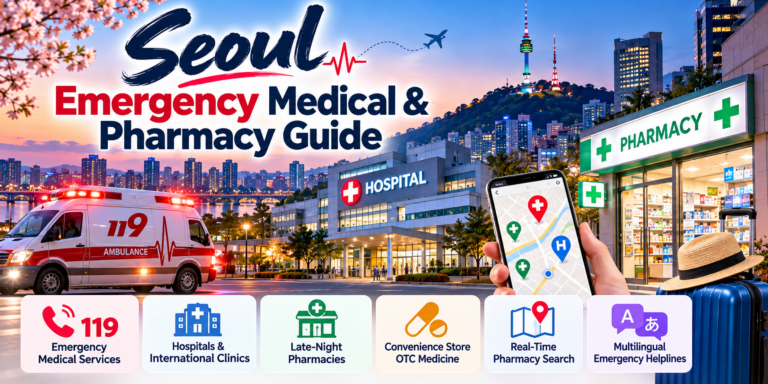
Getting sick, experiencing a sudden allergic reaction, or needing prescription medicine unexpectedly can be one of the most stressful experiences when traveling in Seoul. Language barriers, unfamiliar healthcare systems, and differing operating hours can make finding simple medical help feel overwhelming.
This comprehensive guide is built specifically to help international visitors navigate Seoul’s healthcare landscape quickly and safely. Whether you need an emergency ambulance, an English-speaking international clinic, a 24-hour hospital emergency department, or a designated late-night pharmacy for minor ailments, you will find step-by-step instructions and practical travel tips below.
Important Notice: Hospital, clinic, and pharmacy operating hours can change depending on public holidays, seasonal schedules, or local administrative updates. Always verify current information, double-check official maps, and call the venue directly before visiting whenever possible.
🚑 1. Immediate Life-Threatening Emergency? → Call 119
If you or someone you are traveling with experiences a severe, acute, or life-threatening medical situation, do not attempt to walk to a pharmacy or search for a private clinic. Dial 119 immediately from any Korean mobile phone, local SIM card, eSIM, or public telephone.
☎️ Emergency Medical Services — 119
Call 119 immediately for:
- Difficulty breathing or sudden severe shortness of breath
- Severe chest pain, pressure, or symptoms of a heart attack
- Uncontrollable severe bleeding
- Sudden loss of consciousness, fainting, or unresponsiveness
- Serious traumatic injuries, fractures, or major falls
- Severe allergic reactions (anaphylaxis) with facial swelling or airway obstruction
- Sudden numbness, weakness in the face or limbs, or speech difficulty (stroke symptoms)
- Any other sudden life-threatening medical emergency
How 119 Works for International Tourists:
- Operating Hours: 24 hours a day, 365 days a year, nationwide.
- Cost: Ambulance dispatch by the public emergency system (119) is free of charge in South Korea. (Hospital treatment and emergency room fees will apply later).
- Language Assistance: If you do not speak Korean, stay on the line and clearly state your language to the operator (e.g., “English, please” or “Chinese, please”). The 119 dispatcher will connect a multi-way interpretation service (such as BBB Korea or the Tourist Information translation service) to assist you while dispatching an emergency crew to your GPS location.
🚓 Police Emergency — 112
Call 112 for non-medical emergencies requiring law enforcement:
- Theft, pickpocketing, or stolen passports/wallets
- Physical assault, harassment, or dangerous disputes
- Traffic accidents involving personal injury or vehicle damage
- Immediate personal safety concerns or active crime scenes
Rule of Thumb: For any physical health crisis, acute body pain, or injury, call 119 first. Do not waste critical time searching for a local pharmacy on a map when facing a true medical emergency.
🏥 2. Serious Medical Problem? → Emergency Room (ER) & International Hospitals
If your condition is too serious for a general pharmacy but does not require a lights-and-sirens ambulance (e.g., high fever that won’t drop, deep cuts needing stitches, moderate food poisoning, or sprained ankles), you should head to a hospital Emergency Room (응급실, Eong-geup-sil) or an English-friendly International Healthcare Center.
🌏 Finding Hospitals for International Visitors
South Korea boasts world-class medical facilities, but navigating general outpatient clinics usually requires a Korean National Health Insurance card or fluent Korean communication. International visitors should seek out hospitals registered to treat foreign patients.
You can use the official Medical Korea Database to locate accredited hospitals with dedicated international coordinators:
- Source: Medical Korea – Registered Hospitals & Clinics for Foreign Patients
- Information Provided: Hospital location, multi-language support (English, Japanese, Chinese, Russian), specialized departments, direct emergency contact numbers, and English-speaking doctor schedules.
🏥 International Healthcare Centers in Major Seoul Hospitals
Many of Seoul’s premier university hospitals operate specialized International Healthcare Centers (IHC). These departments provide English-speaking coordinators, assistance with international travel insurance claims, and English medical reports.
Major University Hospitals with International Clinics:
- Severance Hospital (Shinchon / Mapo area)
- Specialty: One of the oldest and largest international clinics in Korea with dedicated full-time English-speaking staff.
- Seoul National University Hospital (SNUH – Hyehwa / Jongno area)
- Specialty: Top-tier general hospital located close to Central Seoul and historic palace districts.
- Samsung Medical Center (Gangnam area)
- Specialty: Advanced diagnostic center and emergency department convenient for visitors staying in southern Seoul.
- Asan Medical Center (Songpa / Jamsil area)
- Specialty: Comprehensive emergency care center near Lotte World and Eastern Seoul.
- Seoul St. Mary’s Hospital (Banpo / Express Bus Terminal area)
- Specialty: Excellent international center accessible from Central and Gangnam districts.
Key Questions to Ask When Calling a Hospital:
When calling a hospital front desk or emergency department, use these simple phrases:
- “Do you have an International Healthcare Center with English coordination?”
- “Is an English interpreter or English-speaking doctor available in the Emergency Room right now?”
- “Do you accept international travel health insurance direct billing, or do I pay upfront with a credit card?”
ER vs. Outpatient Tip: General outpatient clinics in Korean hospitals usually close by 5:00 PM or 6:00 PM on weekdays and around 1:00 PM on Saturdays (closed Sundays). Outside these hours, you must enter through the Emergency Medical Center (응급의료센터) entrance, which operates 24/7. Emergency room visits carry higher base triage fees than standard day clinics.
💊 3. Need Medicine Late at Night? → Public Late-Night Pharmacies
If you are experiencing minor ailments late at night—such as a mild headache, indigestion, slight motion sickness, a minor burn, or a seasonal cold—you do not necessarily need an expensive emergency room visit. Seoul operates a system of Public Late-Night Pharmacies (공공심야약국).
🕙 What is a Public Late-Night Pharmacy?
- Typical Late-Night Hours: 10:00 PM – 1:00 AM.
- Official Designation: Public Late-Night Pharmacies are subsidized and certified by the Seoul Metropolitan Government and local district offices to ensure local residents and tourists have safe access to licensed pharmacists during night hours.
🟢 Public Late-Night Pharmacy vs. 🔵 Late-Opening Pharmacy
Understanding this distinction prevents unnecessary late-night trips across the city:
| Feature | 🟢 Public Late-Night Pharmacy (공공심야약국) | 🔵 Late-Opening Pharmacy (일반 심야/야간약국) |
| Status | Officially designated & monitored by Seoul City | Private pharmacy choosing to extend business hours |
| Pharmacist | Licensed pharmacist guaranteed on-duty | Dependent on individual store owner schedule |
| Closing Time | Open 10:00PM~1:00AM on operating days | Varies widely (e.g., closes at 9:30 PM or 11:00 PM) |
| Reliability | High (Mandated operating calendar) | Moderate (May close early without online updates) |
🛒 4. Convenience Store Medicine (24/7 Over-The-Counter Drugs)
When it is past 1:00 AM and all nearby pharmacies are closed, South Korea permits 24-hour convenience stores (such as GS25, CU, Seven-Eleven, and Emart24) to sell a limited selection of basic, non-prescription medicines called Safety Over-The-Counter Drugs (안전상비의약품).
What You Can Buy at Convenience Stores:
- Fever & Pain Relievers (해열진통제): Acetaminophen (Tylenol 500mg, Children’s Tylenol syrup), Ibuprofen (Pencal / Brufen).
- Cold & Flu Medicine (감기약): Basic multi-symptom cold relief capsules (Pancold-A, Panpyrin).
- Digestive Aids (소화제): Tablets to relieve stomach fullness or indigestion (Festal,digestive aids,Bearse).
- Pain Relief Patches (파스): External muscle pain relief patches (Cooling/Warming pain patches for sore feet or back pain).
Important Limit: Convenience stores are legally restricted to selling one package per customer for safety reasons, and they do not stock antibiotics, strong anti-diarrheal medication, or prescription drugs. For specialized medicine, you must visit a licensed pharmacy.
📍 5. Late-Night Pharmacies by Major Seoul Tourist Areas
For international travelers, searching by administrative districts (Gu) can be confusing. Below is a breakdown of key tourist zones mapped to their corresponding district late-night pharmacy resources.
🏯 Gyeongbokgung, Gwanghwamun & Bukchon (Jongno-gu Area)
- Popular for visitors staying near: Gyeongbokgung Palace, Anguk Station, Bukchon Hanok Village, Insadong, Seochon, Gwanghwamun Square.
- Local Medical Hub: Jongno-gu has a high concentration of traditional pharmacies along the main Jongno street (Jongno 3-ga / Jongno 5-ga).
- Action: Search for Jongno-gu Public Late-Night Pharmacies or head toward major station exits along Line 1.
🛍️ Myeongdong, City Hall & Namsan (Jung-gu Area)
- Popular for visitors staying near: Myeongdong Shopping Street, Euljiro, Namsan Cable Car, Namdaemun Market, Seoul Station.
- Local Medical Hub: Myeongdong features several pharmacies with English and Chinese-fluent staff along the main pedestrian strip. Late-night pharmacies operate regularly around Euljiro 3-ga and Dongdaemun.
- Action: Search for Jung-gu Public Late-Night Pharmacies or ask hotel concierges near Myeongdong Station.
🎨 Hongdae, Sinchon & Yeonnam-dong (Mapo-gu Area)
- Popular for visitors staying near: Hongik University Station, Yeonnam-dong café street, Sinchon, Sangsu-dong, Mangwon-dong.
- Local Medical Hub: Hongdae’s nightlife means several pharmacies near Hongik Univ. Station (Line 2 / AREX) extend operating hours past midnight, especially on weekends.
- Action: Search for Mapo-gu Public Late-Night Pharmacies. Severance Hospital Emergency Room is also located nearby in Sinchon.
🌙 Itaewon, Haebangchon & Hannam-dong (Yongsan-gu Area)
- Popular for visitors staying near: Itaewon Antique Street, Haebangchon (HBC), Hannam-dong fashion district, Yongsan Station.
- Local Medical Hub: Itaewon is one of the most international districts in Seoul. Pharmacies located on the main Itaewon boulevard frequently have English-speaking pharmacists.
- Action: Search for Yongsan-gu Public Late-Night Pharmacies along Itaewon-ro.
🏙️ Gangnam, COEX & Apgujeong (Gangnam-gu Area)
- Popular for visitors staying near: Gangnam Station, Yeoksam, Samseong (COEX), Apgujeong Rodeo, Garosu-gil (Sinsa-dong).
- Local Medical Hub: Gangnam has a dense concentration of medical centers and 24-hour pharmacies operating near major subway transfer hubs.
- Action: Search for Gangnam-gu Public Late-Night Pharmacies along Teheran-ro or near Gangnam Station Exit 10/11.
🗺️ 6. How to Search for Open Pharmacies in Real-Time
Because online maps do not always reflect holiday closures or sudden schedule changes, use these reliable tools and search terms:
1. Official Seoul Metropolitan Government Portal
The primary government database tracks real-time duty schedules for certified pharmacies:
- Search Resource: Official Seoul Public Late-Night Pharmacy Directory
- Checkable Details: Street address, exact telephone number, operating calendar, and today’s closing time.
2. Using Navigation Apps (Naver Map vs. Google Maps)
While Google Maps is widely used globally, Naver Map and KakaoMap provide significantly more accurate, real-time operating hours within South Korea.
Recommended Korean Search Terms for Navigation Apps:
Copy and paste these exact Korean terms into Naver Map or KakaoMap:
- 약국 (Yak-guk) = Pharmacy
- 심야약국 (Sim-ya yak-guk) = Late-Night Pharmacy
- 24시 약국 (24-si yak-guk) = 24-Hour Pharmacy
- 공공심야약국 (Gong-gong sim-ya yak-guk) = Official Public Late-Night Pharmacy
- 응급실 (Eong-geup-sil) = Hospital Emergency Room
Pro Tip: Before walking or taking a taxi to a late-night pharmacy listed on a map, always place a quick phone call first. If someone answers “Yoboseyo?”, you know they are open!
🗣️ 7. Useful Korean Phrases at a Pharmacy or Hospital
If you visit a local Korean pharmacy without an English translator, showing these phrases on your phone screen will help the pharmacist give you the correct over-the-counter medicine.
Describing Symptoms (증상 설명)
- “I need medicine for a cold.”
- 한글: 감기약 좀 주세요.
- Pronunciation: Gam-gi-yak jom ju-se-yo.
- “I have a headache / muscle pain.”
- 한글: 두통 / 근육통이 있어요.
- Pronunciation: Du-tong / Geun-yuk-tong-i is-seo-yo.
- “I have an upset stomach / indigestion.”
- 한글: 소화가 안 되고 배가 아파요.
- Pronunciation: So-hwa-ga an doe-go bae-ga a-pa-yo.
- “I have diarrhea / nausea.”
- 한글: 설사 / 구토를 해요.
- Pronunciation: Seol-sa / Gu-to-reul hae-yo.
- “I have a skin allergy / itchiness.”
- 한글: 피부 알레르기 / 가려움증이 있어요.
- Pronunciation: Pi-bu al-le-reu-gi / Ga-ryeo-um-jjeung-i is-seo-yo.
- “Do you have painkillers like Tylenol or Ibuprofen?”
- 한글: 타이레놀이나 이부프로펜 있어요?
- Pronunciation: Ta-i-re-nol-i-na I-bu-pro-pen is-seo-yo?
Asking for Usage Instructions (복용법 문의)
- “How many times a day should I take this?”
- 한글: 하루에 몇 번 먹어야 하나요?
- Pronunciation: Ha-ru-e myeot beon meog-eo-ya ha-na-yo?
- “Do I take this before or after meals?”
- 한글: 식전에 먹나요, 식후에 먹나요?
- Pronunciation: Sik-jeon-e meong-na-yo, sik-hu-e meong-na-yo?(Tip: Sik-hu 30-bun = 30 minutes after meals).
📞 8. Important Emergency & Multi-Lingual Helpline Directory
Save these essential numbers in your smartphone contacts before exploring Seoul:
| Service | Phone Number | Operating Hours | Primary Function & When to Call |
| 🚑 Emergency Medical Services | 119 | 24 / 7 | Severe medical emergencies, fire, rescue, and ambulance dispatch. |
| 🚓 Police Emergency | 112 | 24 / 7 | Crime reports, theft, personal safety threats, and police aid. |
| 𝑲 Korea Travel Helpline | 1330 | 24 / 7 | Tourist interpretation (English, Mandarin, Japanese, Russian), travel complaints, and emergency guidance. |
| 🏙️ Seoul Dasan Call Center | 120 | 24 / 7 | General Seoul municipal information, public transit queries, and foreign language support. |
| 🛂 Immigration Contact Center | 1345 | Weekdays | Visa questions, stay extension guidance, and legal entry status queries. |
| 🩺 BBB Korea Translation | 1588-5644 | 24 / 7 | Free volunteer multi-language translation service via phone. |
📌 Checklist Before Visiting a Hospital or Pharmacy
To ensure a smooth visit without unnecessary back-and-forth trips, keep these preparation steps in mind:
- Bring Your Original Passport: Hospitals and emergency rooms require valid government-issued photo identification (passport) to open a patient file.
- Keep Travel Insurance Documents Handy: Carry a digital or physical copy of your international travel medical insurance policy, including policy numbers and emergency claim hotlines.
- Carry Credit Cards and Cash: Korean pharmacies and hospital emergency rooms accept major international credit cards (Visa, Mastercard, AMEX), but having small emergency cash (KRW) is recommended.
- List Current Medications & Allergies: Keep a note on your phone listing any chronic conditions, prescription drugs you take regularly, or severe drug allergies (e.g., penicillin allergy).
- Take Photos of Korean Signs: If you are looking for a specific pharmacy recommended online, take a screenshot of its name written in Hangul (e.g., OO약국) so you can show taxi drivers or passersby for directions.
🔗 Official Emergency Resources & Links
- 🚑 Seoul Emergency & Medical Info: Official Seoul Foreign Resident Portal
- 💊 Seoul Late-Night Pharmacy Locator: Seoul Metropolitan Government Public Pharmacy Finder
- 🏥 Accredited Foreign Patient Hospitals: Medical Korea Official Directory
- 🧳 24/7 Tourist Assistance: Korea Tourism Organization 1330 Helpline
⚠️ Medical Disclaimer
The contents of this guide are provided for general informational and educational travel purposes only and do not constitute professional medical advice, diagnosis, or treatment. Medical availability, emergency clinic staffing, pharmacy locations, and operating hours are subject to change without notice. Always verify details directly with official municipal services, medical providers, or local emergency authorities. In the event of a life-threatening health crisis, immediately contact 119 or proceed to the nearest hospital emergency department.