
Seoul Pass Finder
Which Card Is Best for You?
Climate Card, T-money, or WOWPASS?
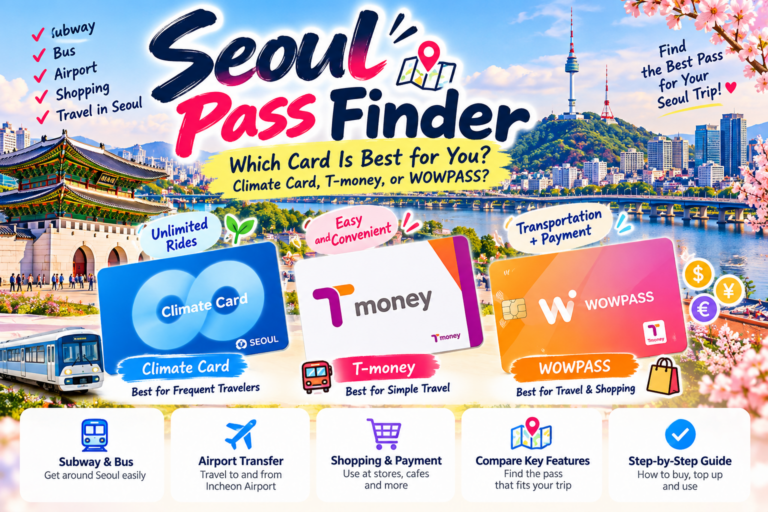
Choosing the right transportation or travel card can make getting around Seoul much easier. Seoul has an extensive subway and bus network, and most visitors will use public transportation several times during their trip. However, different cards are designed for different travel needs.
Seoul Pass Finder is a simple travel-planning tool designed to help international visitors compare popular transportation and travel card options before their trip.
Instead of choosing a card simply because it is popular, think about how long you will stay, how often you will use public transportation, where you plan to travel, and whether you also want payment functions.
Answer a few questions below and use the result as a starting point for choosing a card that fits your Seoul itinerary.
Get a recommendation, understand the differences, learn how to buy and use the card, and check the important conditions — all in one place.
🚌 Seoul Pass Finder
🛒 How to Buy
🚇 How to Use
⚠️ Important Tips
Find the best transportation or payment card for your Seoul trip.
Q1. How long will you stay in Korea?
1 Day · 2 Days · 3 Days · 5 Days · 7 Days · 10+ Days
The length of your trip can affect which type of card is practical.
A short visit may not require a long-term transportation pass, especially if you plan to stay in one neighborhood and make only a few subway or bus trips.
For a longer Seoul stay, a transportation-focused option may become more useful if you expect to travel around the city every day.
Your trip length should therefore be considered together with your expected transportation usage rather than by itself.
Q2. Where will you travel?
🇰🇷 Seoul Only
Myeongdong, Hongdae, Gangnam, Gyeongbokgung, Insadong, Itaewon, Dongdaemun, Jamsil, and other Seoul destinations.
If most of your itinerary is inside Seoul, a Seoul-focused transportation option may be easier to consider.
✈️ Seoul + Incheon
Incheon Airport, Songdo, Incheon Chinatown, and other destinations outside central Seoul.
If your itinerary includes Incheon or airport transportation, check the coverage carefully. Do not assume that a Seoul transportation pass automatically covers every airport route.
🚆 Seoul + Gyeonggi
Suwon, Goyang, Namyangju, and other destinations in Gyeonggi Province.
Travel outside Seoul is an important factor when choosing a transportation product. Some products are designed primarily around Seoul transportation services, while your itinerary may require additional fares for trips outside the covered area.
🗺️ Seoul + Several Regions
Seoul plus Busan, Gyeongju, Jeonju, Nami Island, or other Korean destinations.
If you are taking intercity trains, express buses, or other transportation between regions, a Seoul-focused transportation card may not cover the entire journey.
In this case, think of your Seoul transportation card as one part of your overall transportation plan, rather than as a pass for your entire Korea trip.
Q3. How many public transport rides per day?
🚶 1–2 rides
You plan to use public transportation only occasionally.
For example, you may spend most of the day walking around Myeongdong, Insadong, Hongdae, or another compact neighborhood and use the subway or bus only once or twice.
In this situation, paying for individual transportation trips may be worth considering.
🚌 3–4 rides
You expect to use buses and subways several times each day.
This is a common travel pattern for visitors who plan to visit several attractions in different parts of Seoul.
Compare the expected transportation cost with the price and coverage of the available cards.
⚡ 5+ rides
You plan to move around Seoul frequently every day.
If your itinerary includes several districts and multiple subway or bus journeys each day, a transportation-focused option may become more attractive.
However, the final choice should still depend on the exact coverage, validity period, and current price of the product.
Q4. Do you want payment features too?
🚇 Transportation is my priority
You mainly need a card for buses and subway travel.
If transportation is your main concern, focus on:
- Subway coverage
- Bus coverage
- Validity period
- Service area
- Daily or period-based conditions
- Airport transportation
- Purchase and activation requirements
💳 Transportation + Shopping & Payments
You also want a tourist-friendly payment card.
If you want to use one card for more than transportation, look carefully at the payment functions and where the card can be used.
A payment-oriented travel card may be convenient for visitors who want to combine transportation-related functions with everyday purchases.
Q5. What is your travel style?
⚡ I move around a lot
You plan several destinations every day.
Your itinerary may include Gyeongbokgung in the morning, Myeongdong in the afternoon, Hongdae in the evening, and another neighborhood at night.
For this type of trip, transportation frequency and coverage become particularly important.
🚶 Balanced sightseeing
You plan a few destinations each day.
You may spend several hours in one neighborhood before moving to another area.
This travel style gives you more flexibility and may not require the same transportation usage as a very intensive itinerary.
☕ Slow travel
You mostly stay around one or two areas.
If you prefer cafés, restaurants, shopping, and local neighborhoods rather than visiting many attractions every day, your transportation usage may be relatively low.
In this situation, consider whether a period-based transportation product provides enough value compared with paying for individual trips.
Find My Best Card
Seoul Pass Finder uses your answers to provide a starting recommendation based on your travel duration, destinations, transportation frequency, payment needs, and travel style.
The result is not a guarantee that one card will always be cheaper or better.
Your actual transportation costs can change depending on your itinerary, the number of trips you make, the routes you use, and the latest pricing and usage conditions.
Always check the latest official information before purchasing a transportation pass or travel card.
How Seoul Pass Finder Works
Seoul Pass Finder was created to make the card-selection process easier for international visitors.
There are several popular card options available to travelers in Seoul, but they serve somewhat different purposes. A visitor staying for three days and traveling around Seoul extensively may have different needs from someone staying for two weeks and spending most of the time in one neighborhood.
The tool therefore considers several factors instead of relying on a single question.
Your answers are used to consider:
- Length of stay
- Travel area
- Daily public transportation usage
- Transportation versus payment needs
- Travel style
- Frequency of movement between destinations
The result is designed to help you narrow down your options, not to replace official product information.
Before purchasing, check the current price, coverage, activation method, validity period, refund conditions, supported transportation services, and other restrictions through the official provider.
Which Pass Is Right for You?
Climate Card
The Climate Card is primarily associated with public transportation use within its applicable service area.
It may be worth considering for visitors who plan to use Seoul’s public transportation frequently during their stay.
It can be particularly relevant when your itinerary involves repeated subway and bus journeys around Seoul.
Before purchasing, check the latest information regarding:
- Validity period
- Eligible subway and bus services
- Service area
- Airport-related transportation
- Purchase method
- Physical or mobile-card availability
- Current price and usage conditions
Coverage is important because a transportation product designed around Seoul services may not automatically cover every journey outside the applicable area.
T-money Card
A T-money Card is a widely used transportation and payment card in Korea.
For visitors, one of its practical advantages is flexibility. Instead of purchasing a multi-day transportation pass, travelers can use the card for individual transportation trips and add balance when necessary.
T-money can be useful for visitors who:
- Have an unpredictable itinerary
- Want flexibility during their trip
- Use public transportation but do not want a fixed-duration pass
- Plan to travel between different destinations
- Prefer to pay for transportation as they use it
It is also useful to understand the difference between a transportation card and a transportation pass.
A reloadable transportation card generally works by deducting fares from the available balance, while a period-based pass may operate under different validity and coverage conditions.
Check the latest official T-money information before purchasing or using the card.
WOWPASS
WOWPASS is designed as a tourist-oriented payment and travel card.
For visitors who want payment functionality in addition to transportation-related convenience, it may be an option worth comparing with other cards.
Travelers considering WOWPASS should check:
- Payment functions
- Transportation functions
- Where the card can be used
- Currency exchange features
- Reload methods
- Fees
- Refund or remaining-balance conditions
- Current tourist benefits
The most suitable option depends on how you intend to use the card during your trip.
Climate Card vs T-money vs WOWPASS
The three options should not simply be viewed as competing products with one universal winner.
They have different purposes and may suit different types of travelers.
| Card | Main Focus | May Suit |
|---|---|---|
| Climate Card | Public transportation | Travelers making frequent trips within applicable Seoul coverage |
| T-money | Flexible transportation payment | Travelers who prefer paying for individual trips |
| WOWPASS | Tourist payment + travel convenience | Visitors looking for broader payment-related functions |
This comparison is only a starting point. Prices, coverage, supported services, and conditions can change.
What Should You Consider Before Choosing a Pass?
1. Length of Stay
Think about how many days you will spend in Seoul.
A transportation option designed for repeated use may be more relevant for a longer stay, while a short visit may require a simpler solution.
Do not choose a pass only because its validity period matches your hotel booking. Consider how many days you will actually use public transportation.
2. Daily Transportation Usage
Estimate how many times you expect to use buses and subways each day.
For example:
Low usage: 1–2 rides per day
Moderate usage: 3–4 rides per day
High usage: 5 or more rides per day
Your actual itinerary is more useful than simply assuming that a multi-day pass will save money.
3. Travel Destinations
Check where you are going.
If your itinerary is mainly:
Myeongdong → Gyeongbokgung → Insadong → Hongdae
your transportation needs may be different from an itinerary that includes:
Seoul → Suwon → Incheon → Gyeonggi Province
Always check whether the transportation services and areas you plan to use are covered.
4. Airport Transportation
Airport transportation deserves special attention.
Do not assume that a Seoul transportation pass includes every journey between Incheon Airport and Seoul.
Airport railroad services, airport buses, subway services, and other transportation products can have different payment and coverage conditions.
If your trip starts or ends at Incheon Airport, check the airport transportation rules separately.
5. Shopping and Payment Needs
Some travelers mainly need transportation.
Others want a card that can also be used for shopping, restaurants, cafés, and other purchases.
If payment functionality matters to you, compare the payment features separately from the transportation benefits.
6. Validity and Activation
Check exactly when the card becomes active.
Some products may have a defined validity period or specific activation rules.
Also check:
- Expiration
- Refund policy
- Remaining balance
- Reload conditions
- Purchase locations
- Mobile versus physical card requirements
These details can be just as important as the headline price.
A Sample Seoul Travel Comparison
Example 1: Three-Day Seoul City Trip
You stay in Myeongdong for three days and visit:
- Gyeongbokgung
- Bukchon
- Insadong
- Hongdae
- Dongdaemun
- N Seoul Tower
You may use public transportation several times each day.
For this type of itinerary, compare a transportation-focused option with a flexible transportation card and consider the total number of expected rides.
Example 2: Seven-Day Seoul Trip
You stay for one week and explore different districts almost every day.
Your itinerary includes Gangnam, Jamsil, Hongdae, Myeongdong, Jongno, and Yeouido.
Because you expect frequent transportation use, the validity period and transportation coverage become particularly important.
Example 3: Korea Multi-City Trip
You spend four days in Seoul, then travel to Busan and Gyeongju.
In this case, do not evaluate your transportation card only by the total number of days in Korea.
First separate your transportation needs:
Seoul transportation
Intercity transportation
Local transportation in other cities
A Seoul-focused transportation product may only address the first part of your journey.
When a Transportation Pass May Not Be Necessary
A transportation pass is not automatically the right choice for every traveler.
You may use relatively little public transportation if you:
- Stay near your main attractions
- Walk frequently
- Spend most of your time in one neighborhood
- Use taxis occasionally
- Stay for only a short time
- Have a sightseeing itinerary with few daily movements
In these cases, compare the expected cost of individual transportation trips with the price and conditions of a pass.
When a Transportation Pass May Be More Useful
A transportation-focused option may be worth considering if you:
- Use buses and subways several times every day
- Visit multiple Seoul districts
- Stay in Seoul for several days
- Regularly transfer between subway lines
- Plan an active sightseeing schedule
- Want a predictable transportation arrangement
Again, actual value depends on the current product conditions and your itinerary.
Important Information
Transportation passes and travel cards may have different prices, validity periods, service areas, supported transportation services, purchase methods, and usage conditions.
These details can change over time.
Seoul Pass Finder provides general travel-planning guidance and should be used as a starting point for comparison.
It does not replace official transportation or card-provider information.
Before purchasing or using a pass, confirm the latest:
- Price
- Validity
- Service area
- Transportation coverage
- Airport coverage
- Purchase method
- Activation method
- Refund conditions
- Reload conditions
- Card restrictions
If the information shown on this page differs from the official provider’s current information, follow the official provider’s latest terms and conditions.
Frequently Asked Questions
Is Seoul Pass Finder suitable for first-time visitors?
Yes. The tool is designed to simplify the comparison process for visitors who may not be familiar with Seoul’s transportation cards.
Instead of asking travelers to understand every product feature immediately, it starts with their travel plans and transportation needs.
Is the recommended pass always the cheapest option?
No.
The recommendation is based on the information entered into the tool. Your actual cost depends on your transportation usage, itinerary, card price, fees, coverage, and current product conditions.
A card that appears suitable for one traveler may not be suitable for another traveler with a different itinerary.
Can I use every pass on all public transportation?
No.
Transportation coverage depends on the specific product.
Before purchasing, check the official coverage information for the subway lines, buses, airport services, regional transportation, and other services you plan to use.
Does every pass include airport transportation?
No.
Airport transportation should always be checked separately.
In particular, do not assume that a Seoul transportation pass automatically covers every route between Incheon Airport and Seoul.
Can I use a transportation card outside Seoul?
This depends on the specific card and transportation service.
If your trip includes Suwon, Incheon, Gyeonggi Province, Busan, Gyeongju, or other destinations, check the relevant coverage before traveling.
Should I buy a card before arriving in Korea?
That depends on the product.
Some cards or passes may be available through online channels, while others may be purchased after arriving in Korea.
Check the official purchase instructions before your trip.
Should I check official information before buying?
Yes.
Prices, service areas, validity periods, transportation coverage, purchase methods, and policies can change.
Seoul Pass Finder helps you understand the differences and identify a suitable starting point, but the official provider should always be your final source for current purchasing and usage information.
Plan Your Seoul Transportation Before You Arrive
Choosing a transportation card does not need to be complicated.
Start with four simple questions:
How long will I stay?
How often will I use public transportation?
Where will I travel?
Do I need transportation only, or transportation plus payment features?
Once you understand these four points, it becomes much easier to compare Climate Card, T-money, and WOWPASS.
Use Seoul Pass Finder to organize your travel plans, review the available options, and then confirm the latest official information before making your purchase.
The right card is the one that matches your actual Seoul itinerary — not simply the card with the most features.