
Seoul Itineraries for Every Trip
Planning a trip to Seoul can be difficult when there are so many places to see, neighborhoods to explore, foods to try, and different experiences to choose from.
Seoul is a large city, and popular attractions are spread across many different neighborhoods. A good itinerary is therefore not simply a list of famous places. It should also consider travel time, walking distance, subway transfers, opening hours, meal times, rest periods, and the pace of your trip.
Our Seoul itineraries are designed to help you make the most of your time without trying to see everything in a single day.
Choose an itinerary based on how many days you have, what you want to experience, and how much time you want to spend traveling between destinations.
Whether you are visiting Seoul for a long weekend or spending a full week in the city, the goal is to create a realistic schedule that leaves enough time to actually enjoy each destination.
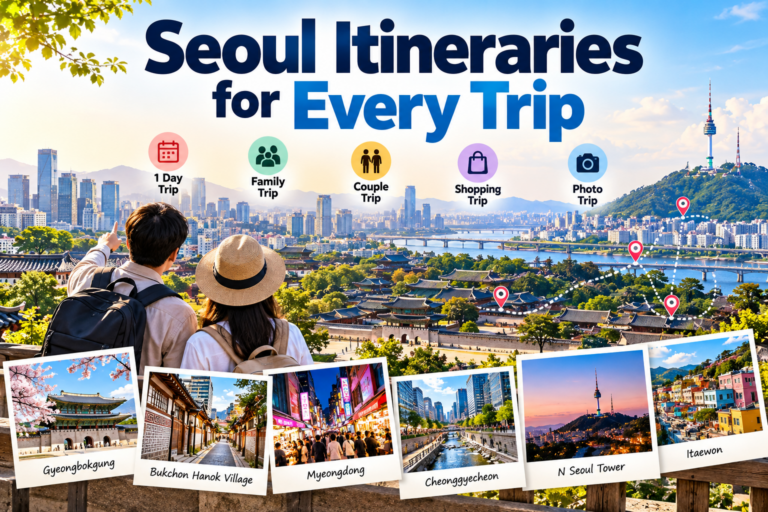
Choose Your Seoul Itineraries
Seoul 3-Day Itinerary
Perfect for: First-time visitors with limited time
Three days in Seoul is enough to experience several of the city’s major attractions, but your schedule needs to be organized carefully.
Instead of trying to visit every famous destination, focus on a few important areas and group nearby attractions together.
Highlights:
- Gyeongbokgung Palace
- Bukchon Hanok Village
- Seongsu-Dong
- Myeongdong
- N Seoul Tower
- Hongdae
- Cheonggyecheon
Recommended for: Travelers visiting Seoul for a long weekend or short city break.
Travel style: ★★★★☆ Active
With only three days, it is particularly important to avoid unnecessary journeys across the city. Plan each day around a specific area whenever possible.
Seoul 5-Day Itinerary
Perfect for: First-time visitors who want a more relaxed trip
Five days gives you enough time to see Seoul’s major attractions while also exploring different neighborhoods and enjoying Korean food.
Highlights:
- Seoul’s historic attractions
- Traditional neighborhoods
- Myeongdong
- Hongdae
- Seongsu
- Han River
- N Seoul Tower
- Korean food experiences
- Shopping
Recommended for: Travelers who want a balance of sightseeing, food, shopping, and free time.
Travel style: ★★★☆☆ Balanced
Five days also gives you more flexibility when weather conditions change. You can move an outdoor activity to another day without losing an important part of your trip.
Seoul 7-Day Itinerary
Perfect for: Travelers who want to explore Seoul at a slower pace
With seven days, you can go beyond the major tourist attractions and spend more time exploring neighborhoods, cafés, local markets, hidden places, and different sides of Seoul.
Highlights:
- Major Seoul attractions
- Palaces and traditional neighborhoods
- Hongdae
- Seongsu
- Myeongdong
- Han River
- Hidden Gems in Seoul
- Korean food
- Shopping
- Relaxed neighborhood exploration
Recommended for: Travelers who want a deeper Seoul experience.
Travel style: ★★☆☆☆ Relaxed
A longer stay also gives you the opportunity to leave some days flexible. Instead of deciding every activity months before your trip, you can choose some destinations based on weather, events, or your interests after arriving in Seoul.
Which Seoul Itinerary Is Right for You?
| Trip Length | Best For | Travel Style |
|---|---|---|
| 3 Days | First-time visitors with limited time | Fast-paced |
| 5 Days | First-time visitors | Balanced |
| 7 Days | Deeper Seoul experience | Relaxed |
Our simple recommendation
3 days: Focus on Seoul’s essential attractions.
5 days: Add neighborhoods, food, shopping, and more relaxed sightseeing.
7 days: Explore beyond the famous attractions and discover a more local side of Seoul.
The number of days is only a starting point. Your personal travel style is equally important.
Someone who enjoys moving quickly between attractions may prefer a more active itinerary, while another traveler may prefer spending several hours in one neighborhood.
Plan Your Days by Area
One of the easiest ways to enjoy Seoul is to avoid crossing the city unnecessarily.
Instead of planning your itinerary only by attraction, consider grouping nearby destinations together.
This can reduce subway transfers, walking between distant stations, and time spent simply getting from one part of Seoul to another.
Historic Seoul
Gyeongbokgung → Bukchon → Insadong → Ikseon-dong
A good combination for travelers interested in Korean history, traditional architecture, cafés, and local streets.
You can spend the morning exploring the palace and surrounding historic areas, then continue toward Insadong and Ikseon-dong for food, cafés, and evening exploration.
Central Seoul
Myeongdong → Namsan → N Seoul Tower → Cheonggyecheon
Good for first-time visitors who want sightseeing, shopping, food, and evening views.
This combination works particularly well when you want to finish your day with an evening walk or city view.
Young & Trendy Seoul
Hongdae → Yeonnam-dong
Good for cafés, shopping, street performances, and nightlife.
Because these areas can be enjoyed at a relatively flexible pace, they are also useful when you do not want a tightly scheduled sightseeing day.
Modern Seoul
Seongsu → Seoul Forest
A good choice for cafés, pop-up stores, fashion, and a more contemporary side of Seoul.
Seongsu can be especially interesting for travelers who want to experience a different side of Seoul beyond traditional tourist attractions.
Riverside Seoul
Han River → Han River Park → Sunset / Evening Walk
Ideal for slowing down after a busy day of sightseeing.
The Han River can also work well as an evening activity rather than a full-day destination.
Build Your Own Seoul Day
If you prefer to create your own itinerary, use this simple structure:
Morning
Choose one major attraction.
↓
Lunch
Try a Korean dish in the neighborhood.
↓
Afternoon
Explore a nearby neighborhood or smaller attraction.
↓
Break
Take a café or rest break.
↓
Evening
Choose one evening activity.
This approach gives you flexibility without making your day feel unorganized.
It also prevents the common problem of spending the entire day rushing from one location to another.
Don’t Plan Too Many Attractions
A common mistake when visiting Seoul for the first time is trying to visit too many places in one day.
For example:
Palace → Museum → Shopping → Market → N Seoul Tower → Hongdae
may look exciting on paper, but the actual journey can involve:
Walking → Subway → Transfer → Walking → Waiting → More Walking
By the time you reach the final destination, you may have less energy to enjoy it.
Instead, try:
One major attraction + one neighborhood + one evening activity
This usually creates a more comfortable travel day.
The purpose of an itinerary is not to maximize the number of places you can physically visit. It is to help you enjoy the places you choose.
Consider Travel Time, Not Just Distance
Two destinations may look close on a map but still require considerable walking or public transportation.
When planning your day, consider:
- Walking time
- Subway transfers
- Station exit location
- Waiting time
- Traffic
- Opening hours
- Meal times
- Your energy level
- Weather conditions
- Time needed for photographs
A destination that appears only a few kilometers away may take much longer to reach during busy periods.
This is especially important for families, older travelers, and anyone carrying luggage.
Think About Opening Hours
Opening hours should be considered when building your itinerary.
A palace, museum, market, restaurant, shopping center, and observation deck may all have different operating schedules.
Before leaving your hotel each morning, check whether the destinations you plan to visit are open.
Also check whether a destination has a last admission time.
This is particularly important when you plan to visit several attractions in the afternoon.
A little planning can prevent arriving at a destination only to discover that admission has already ended.
Plan Around Meals
Food is an important part of a Seoul trip, so do not treat meals as an afterthought.
Instead of traveling across the city just to eat at one restaurant, consider choosing restaurants in the neighborhood you are already visiting.
For example:
Gwangjang Market → Jongno sightseeing → Insadong
allows you to combine food and sightseeing in the same general area.
You can also leave some flexibility for discovering a restaurant, bakery, café, or market while walking around.
Include Breaks
A Seoul itinerary can involve considerably more walking than visitors expect.
Subway stations can be large, attractions can cover extensive areas, and moving between destinations may involve additional walking.
For this reason, include regular breaks.
A café stop, lunch break, or short rest can help you maintain your energy for the evening.
You do not need to consider every hour of the day as sightseeing time.
Sometimes sitting in a café and watching the neighborhood is part of the travel experience.
Itinerary by Travel Style
First-Time Visitors
Focus on:
Palaces + Traditional Seoul + Myeongdong + N Seoul Tower + Hongdae
This gives you a good introduction to Seoul’s history, food, shopping, and modern city life.
Couples
Consider:
N Seoul Tower + Ikseon-dong + Han River + Seongsu + Evening Walks
Leave some free time for cafés, photographs, and spontaneous stops.
A less crowded schedule can also make it easier to enjoy meals and explore neighborhoods without constantly watching the clock.
Families with Kids
Consider:
Lotte World + COEX Aquarium + Seoul Forest + Children’s attractions + Han River
Avoid scheduling too many attractions in one day.
Families may also want to consider travel time, restroom availability, meal options, stroller accessibility, and opportunities to take breaks.
Food Lovers
Build your itinerary around neighborhoods rather than individual restaurants.
For example:
Gwangjang Market → Jongno → Insadong → Ikseon-dong
or
Myeongdong → Namdaemun → Korean BBQ / Korean Restaurant
This lets you combine sightseeing and food naturally.
Travelers Looking for Hidden Places
Instead of spending every day around the major tourist attractions, add:
Hidden Gems in Seoul
to your itinerary.
Look for:
- Quiet neighborhoods
- Small local markets
- Scenic viewpoints
- Independent cafés
- Traditional streets
- Local parks
- Lesser-known cultural attractions
This can help create a more personal Seoul experience.
A Practical Daily Rule
Try the:
3–2–1 Seoul Rule
3 — Main places or activities
2 — Proper meals
1 — Flexible activity
For example:
Gyeongbokgung
→ Insadong
→ Ikseon-dong
→ Korean lunch
→ Café break
→ Evening walk
You don’t need to fill every hour of your vacation.
The flexible activity can be something you decide on the day itself.
Leave Room for Unexpected Discoveries
Some of the best travel experiences happen between planned destinations.
You may find:
- A small café
- A local bakery
- A street market
- A temporary pop-up store
- A beautiful photo spot
- A quiet traditional street
- A small independent shop
Don’t make your itinerary so strict that there is no room for these discoveries.
Leaving one or two hours without a fixed destination can make your trip feel less stressful and more spontaneous.
What to Do When the Weather Changes
Seoul’s weather can affect outdoor sightseeing significantly.
If rain is expected, consider moving outdoor attractions to another day and using indoor destinations such as shopping centers, museums, aquariums, cafés, markets, or cultural facilities.
If you have a longer itinerary, keep at least one flexible day or several flexible activities that can be changed according to the weather.
This is one of the advantages of a five- or seven-day itinerary.
You have more opportunities to rearrange your schedule without missing major attractions.
Plan Your Evening Carefully
Seoul is a city that can feel very different after sunset.
Some neighborhoods are particularly interesting in the evening, while others are better suited to daytime sightseeing.
Consider ending different days with activities such as:
- N Seoul Tower views
- Myeongdong shopping
- Hongdae evening streets
- Han River sunset
- Cheonggyecheon evening walk
- Seongsu cafés
- Korean dinner
You do not need to plan a major attraction every night.
Sometimes a relaxed dinner followed by a neighborhood walk is the best way to finish the day.
Before You Start Your Seoul Trip
Check these things before leaving your hotel each morning:
✓ Opening hours
✓ Weather
✓ Subway operating information
✓ Transportation route
✓ Estimated travel time
✓ Restaurant location
✓ Reservation requirements
✓ Last admission time, if applicable
✓ Nearby attractions
Transportation schedules, admission fees, opening hours, and other travel information can change. Check official sources before traveling when the information is important to your plans.
Make Your Itinerary Flexible
A good Seoul itinerary should provide structure without making you feel like you are following a strict timetable.
Think of your itinerary as a framework.
Decide which major attractions you want to visit, identify the neighborhoods you want to explore, and then leave some time for meals, cafés, shopping, photographs, and unexpected discoveries.
If one attraction takes longer than expected, you should be able to adjust the rest of your day without completely changing your trip.
This is particularly useful for first-time visitors because it is difficult to predict exactly how long you will want to spend at each destination.
Make Your Seoul Trip Your Own
There is no single perfect Seoul itinerary.
A traveler visiting Seoul for three days may want to see the famous attractions as efficiently as possible, while someone staying for a week may prefer to slow down and explore neighborhoods.
Choose the pace that works for you.
See the highlights. Explore the neighborhoods. Eat local food. Leave some time to simply enjoy Seoul.
The most memorable trip is not necessarily the one with the longest list of attractions.
It is the one where you have enough time to actually experience the places you visit.
Plan Your Seoul Trip
Short trip?
→ Seoul 3-Day Itinerary
Want a balanced trip?
→ Seoul 5-Day Itinerary
Have more time?
→ Seoul 7-Day Itinerary
Want to understand your expenses?
→ Seoul Travel Budget
Need help choosing transportation?
→ Explore our Seoul transportation guides and Subway Route Finder before planning your daily routes.
Looking for places to visit?
→ Start with our Must-Visit Places in Seoul and then organize destinations by neighborhood.
Your Seoul Trip Starts With a Good Plan
Planning your Seoul trip does not mean creating a schedule for every minute.
Start with the destinations that matter most to you, group nearby places together, consider transportation and walking time, and leave enough space to rest and explore.
Whether you have 3 days, 5 days, or 7 days, Seoul offers enough variety to create a trip that matches your own interests.
Plan smart, travel at your own pace, and enjoy Seoul your way.
A Local’s Note
If you’re visiting for a short trip of about 3 days, I recommend focusing on the famous sights and taking your time getting around. In the Jongno area, you can see a lot of places in a short time.
If you have a more relaxed schedule of about 5 days, I recommend exploring neighborhoods that match your interests and finding the restaurants you want to try.
With 7 days, it would be good to also plan for popular spots outside Seoul in nearby Gyeonggi-do.
If you’re focusing on Seoul for a short trip, you can save travel time by using our Seoul Subway Route Finder, which covers 41 major subway stations, to quickly search your routes.
And if you’re curious about other sights nearby while you’re out, you can search for them with our Nearby Places tool. Make good use of our site’s tools and you’ll have a much fuller trip.