
Bongeunsa Temple
Discover Bongeunsa Temple in the Heart of Gangnam
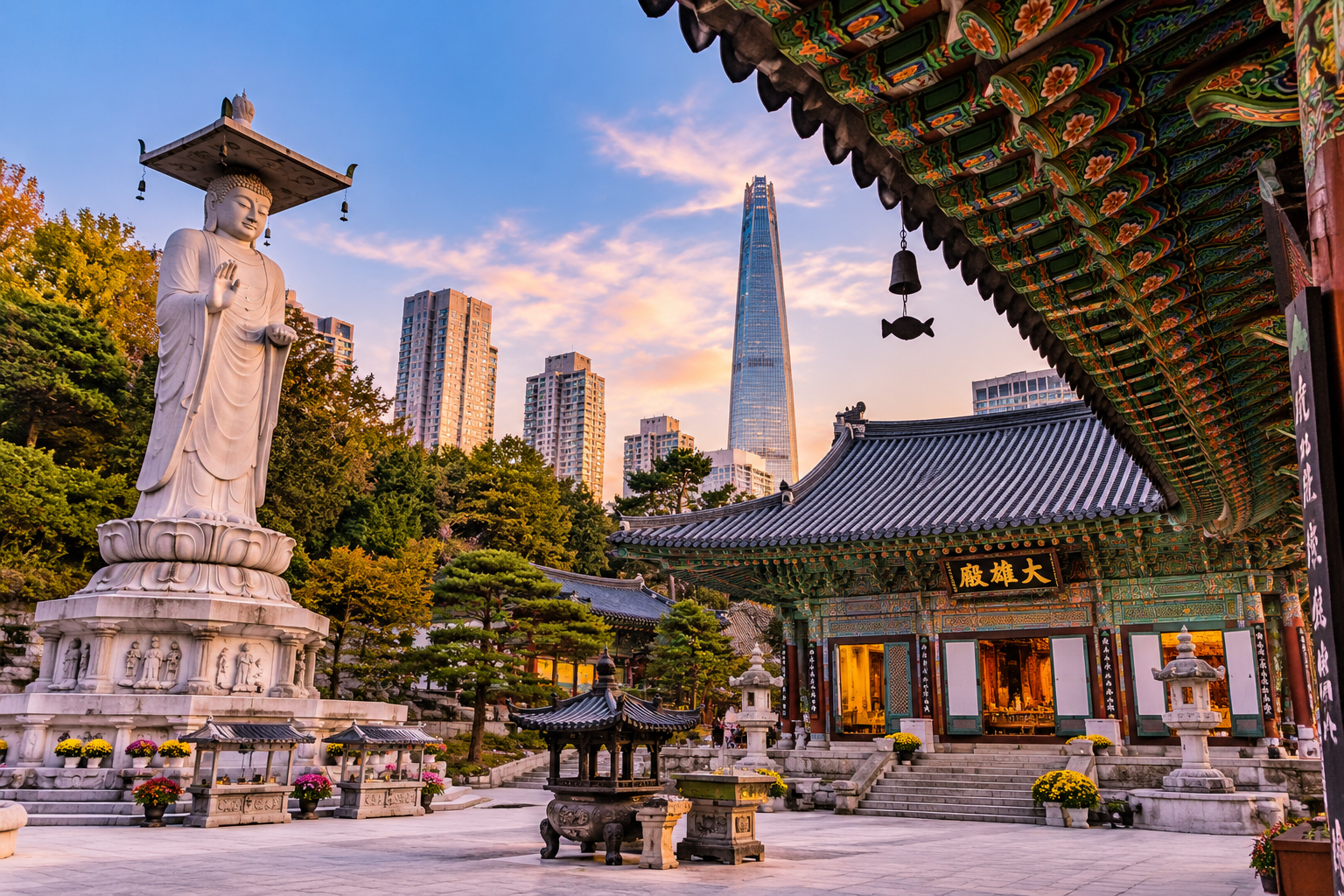
Bongeunsa Temple is one of the most interesting cultural attractions in southern Seoul. Located in the busy Gangnam district, the temple offers visitors an opportunity to experience traditional Korean Buddhist culture while surrounded by modern skyscrapers, shopping malls, offices, and some of Seoul’s most recognizable commercial areas.
What makes Bongeunsa particularly interesting is its location. Just across from the enormous COEX complex, the temple creates a remarkable contrast between old and new Seoul.
One moment you can be walking through one of the busiest commercial districts in the city, and a few minutes later you can enter a peaceful temple complex filled with traditional Korean architecture, trees, stone statues, and quiet walking paths.
For travelers looking for something different from shopping and entertainment in Gangnam, Bongeunsa Temple is an excellent place to slow down and experience another side of Seoul.
A Brief History of Bongeunsa Temple
Bongeunsa has a long history dating back to the Silla period.
The temple was originally established in 794 during the reign of King Wonseong of Silla. It was originally known as Gyeonseongsa and was located near the tomb of King Seongjong.
The temple was later moved to its present location and became known as Bongeunsa.
During the Joseon Dynasty, Bongeunsa became particularly important in the history of Korean Buddhism. The temple was also associated with the revival and support of Buddhist traditions during periods when Buddhism faced restrictions.
Over the centuries, the temple has experienced changes, rebuilding, and periods of difficulty, but it has remained an important Buddhist institution in Seoul.
Today, Bongeunsa continues to function as an active Buddhist temple rather than simply a historical tourist attraction.
This is important to remember when visiting. Travelers are welcome to explore the grounds, but the site should be treated as a living religious and cultural space.
Bongeunsa and Modern Gangnam
The most memorable feature of Bongeunsa may not be a single building but the contrast between the temple and its surroundings.
Gangnam is famous for modern architecture, luxury shopping, high-rise offices, fashion, restaurants, and entertainment.
Bongeunsa provides almost the opposite experience.
Traditional wooden buildings, tiled roofs, Buddhist statues, gardens, and trees create a quieter environment just steps away from the busy streets around COEX.
This contrast makes Bongeunsa a particularly interesting stop for international visitors.
You do not need to travel to a remote mountain temple to see traditional Korean Buddhist architecture. In Bongeunsa, traditional culture exists directly within one of Seoul’s busiest modern districts.
The Giant Maitreya Buddha Statue
One of the most recognizable features of Bongeunsa is the large stone statue of Maitreya Buddha.
The statue stands approximately 23 meters high and can be seen from different parts of the temple grounds.
Its large scale makes it one of the most memorable visual features of the temple.
The statue also creates excellent opportunities for photography, particularly when viewed together with the surrounding trees and traditional buildings.
Take your time when approaching the statue rather than simply photographing it and leaving. The surrounding area provides a good opportunity to observe Buddhist architecture and the atmosphere of the temple.
Traditional Korean Temple Architecture
Bongeunsa contains several traditional buildings and architectural details that can help visitors understand Korean Buddhist architecture.
The roofs, wooden structures, decorative paintings, gates, courtyards, and Buddhist artwork create a strong contrast with the glass and steel buildings surrounding the temple.
Look closely at the painted patterns on the wooden structures.
Traditional Korean Buddhist buildings often feature colorful decorative designs known as dancheong, which were used not only for decoration but also to protect wooden structures and create visual harmony.
For travelers interested in architecture and photography, these details can be just as interesting as the larger buildings.
A Quiet Escape from Gangnam
Gangnam can be overwhelming.
The streets around Gangnam Station and COEX can be busy with commuters, shoppers, tourists, traffic, advertisements, and large crowds.
Bongeunsa provides a place to pause.
The temple grounds have trees, gardens, stone features, and quieter walking areas. The atmosphere can change dramatically depending on the time of day.
In the morning, the temple can feel particularly peaceful. During the afternoon, visitors may come and go while the surrounding city remains active.
Even a short visit can provide a useful break from a busy Seoul itinerary.
Bongeunsa and COEX
One of the biggest advantages of visiting Bongeunsa is its proximity to COEX.
COEX is one of Seoul’s largest convention, shopping, entertainment, and exhibition complexes.
This makes it very easy to combine traditional and modern attractions in one itinerary.
For example, you can begin your day at Bongeunsa Temple, walk through the temple grounds, and then continue to COEX for lunch and shopping.
After exploring COEX, visit Starfield Library and enjoy the impressive indoor architecture before continuing to another Gangnam attraction.
This combination provides a simple way to experience two very different sides of Seoul in one afternoon.
Starfield Library and Bongeunsa
Starfield Library is one of the most photographed indoor spaces in Seoul.
Its enormous bookshelves and open architectural design have made it a popular destination for travelers.
Because Starfield Library is located within COEX, it can easily be combined with Bongeunsa.
A useful itinerary is:
Bongeunsa Temple → COEX → Starfield Library → Dinner in Gangnam
This route requires relatively little travel between destinations and works particularly well on a rainy or extremely hot day.
Temple Stay and Buddhist Experiences
Bongeunsa is also associated with Buddhist cultural programs and temple experiences.
Depending on the current schedule, visitors may be able to participate in programs that introduce aspects of Korean Buddhist culture, meditation, traditional practices, or temple life.
Programs and availability can change, so visitors interested in participating should check the temple’s official information before planning their visit.
A cultural program can provide a much deeper understanding of the temple than simply walking around the grounds.
Photography at Bongeunsa
Bongeunsa is a good location for travelers interested in photography.
The temple offers several types of photographic contrast.
Traditional roofs can be photographed against modern skyscrapers.
The Maitreya Buddha statue provides a strong vertical composition.
Trees and gardens create natural framing around traditional buildings.
In spring and autumn, seasonal colors can add another layer to photographs.
You can also experiment with photographs that include both Bongeunsa’s traditional architecture and the modern buildings around COEX.
This contrast is one of the most distinctive visual characteristics of the area.
Best Time to Visit Bongeunsa
Bongeunsa can be visited throughout the year.
Spring brings fresh greenery and seasonal flowers, while autumn can provide beautiful foliage around the temple grounds.
Summer can be hot and humid, so an early morning visit may be more comfortable.
Winter provides a quieter atmosphere and can offer clear views of the surrounding city.
If photography is your priority, morning light can provide a softer atmosphere and fewer visitors.
Late afternoon can also be interesting because the changing light creates different views of the buildings and surrounding city.
Before visiting, check the Seoul Weather forecast, especially if you plan to combine Bongeunsa with other outdoor attractions.
How Long Should You Spend at Bongeunsa?
You do not need an entire day to visit Bongeunsa.
A short visit of approximately 30 to 60 minutes is enough to walk around the main grounds, see the major buildings, visit the large Buddha statue, and take photographs.
If you are interested in Buddhist culture, architecture, photography, or meditation programs, you may want to spend longer.
Because COEX is nearby, many travelers combine Bongeunsa with several other attractions and spend half a day in the area.
How to Get to Bongeunsa Temple
Bongeunsa is conveniently connected to Seoul’s subway system.
The temple is close to Bongeunsa Station on Seoul Subway Line 9. Take Exit 1 and walk about 5 minutes to the main gate. From Samseong Station (Line 2), use Exit 6, walk through or past COEX, and cross the road to the temple in about 10 minutes.
It is also accessible from the COEX and Samseong area.
This makes Bongeunsa relatively easy to reach from other parts of Seoul.
If you are already visiting COEX, walking to the temple is particularly convenient.
For travelers using multiple subway lines during their trip, our Seoul Subway Route Finder can help you plan a route between Bongeunsa and other Seoul attractions.
A Simple Gangnam Cultural Itinerary
If you want to explore Gangnam beyond shopping, consider this route:
Morning: Visit Bongeunsa Temple.
Late morning: Walk toward COEX.
Lunch: Enjoy Korean or international food around COEX.
Afternoon: Explore Starfield Library and the COEX shopping complex.
Late afternoon: Continue toward another Gangnam neighborhood such as Apgujeong or Sinsa.
Evening: Have dinner in Gangnam.
This itinerary combines Korean Buddhist culture, modern architecture, shopping, food, and contemporary Seoul lifestyle.
Visiting Etiquette
Bongeunsa is an active Buddhist temple, so visitors should behave respectfully.
Keep your voice low in prayer halls and religious areas.
Do not disturb people who are praying or participating in ceremonies.
Follow signs indicating areas that are restricted to visitors.
Dress respectfully and avoid treating religious spaces simply as photo backgrounds.
When taking photographs, be aware of other visitors and worshippers.
The goal is to enjoy the cultural experience while respecting the temple’s religious function.
Bongeunsa Compared with Seoul’s Historic Palaces
Bongeunsa offers a different historical experience from Seoul’s royal palaces.
Gyeongbokgung Palace and Changdeokgung Palace are associated with the Joseon royal court and provide insight into Korea’s royal history.
Bongeunsa represents Korean Buddhist culture and religious heritage.
If you have enough time, visiting both a royal palace and a Buddhist temple can give you a broader understanding of Korean history and culture.
For example, you could visit Gyeongbokgung in northern Seoul on one day and Bongeunsa in Gangnam on another.
Why Visit Bongeunsa?
Bongeunsa is worth visiting because it offers something that many visitors do not expect to find in Gangnam.
It is a peaceful historic temple surrounded by one of Seoul’s most modern commercial districts.
The large Maitreya Buddha statue, traditional architecture, colorful decorative details, quiet gardens, and surrounding skyscrapers create a unique combination that is difficult to reproduce elsewhere in the city.
It is also extremely convenient to combine with COEX, Starfield Library, shopping, restaurants, and other Gangnam attractions.
For travelers who want to experience both traditional Korea and modern Seoul in a single itinerary, Bongeunsa is an excellent stop.
Experience Traditional Korea in Modern Seoul
Seoul is a city where the past and present often exist side by side.
Bongeunsa Temple is one of the clearest examples of this.
Inside the temple grounds, you can experience centuries of Korean Buddhist tradition. Step outside the gate, and you are immediately surrounded by modern buildings, shopping centers, businesses, and the energy of Gangnam.
That contrast is what makes Bongeunsa special.
When planning your Seoul travel itinerary, consider pairing Bongeunsa Temple with COEX, Starfield Library, and Gangnam.
It is an easy way to experience a quieter, more traditional side of Seoul without leaving the heart of the modern city.
🧭 Useful Seoul Travel Tools
Make your visit easier with our free travel tools.
A Local’s Note
Personally, if you’d like to experience Korean temple food culture, I recommend the Templestay program at Bongeunsa Temple. I think it’s the best place to experience temple culture in Gangnam. It’s also within a 10-minute walk of COEX, so it’s nice to visit the two together.