
Gwangjang Market: What to Eat, Opening Hours and Tips (2026)
Last updated: October 2026 · Written by the Seoul Travel Tips team, based in Seoul
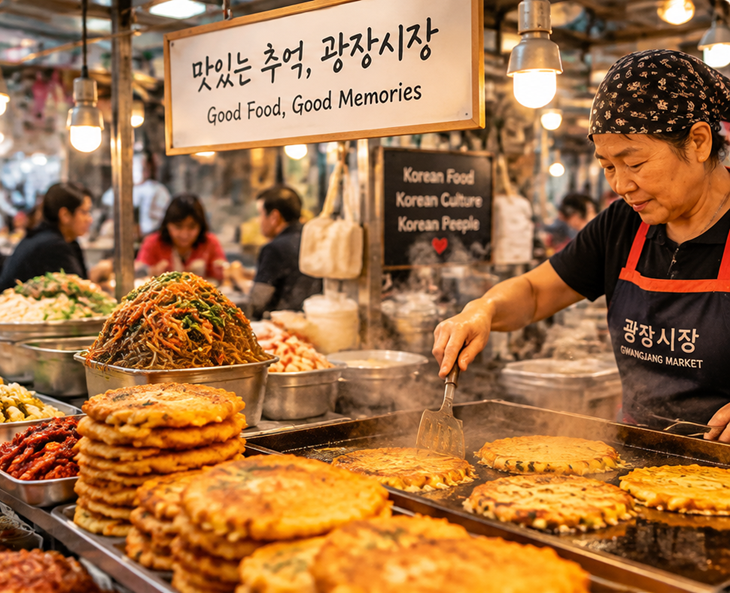
Gwangjang Market is Seoul’s most famous food market and one of the oldest markets in Korea. Opened in 1905 as the country’s first permanent market, it started as a textile and clothing hub — and still is, upstairs. But most visitors come for the food alley: long rows of stalls frying mung bean pancakes, rolling mini gimbap and serving raw beef, with customers squeezed onto benches right in front of the cooks. Here’s what to order, when to go, and how to make the most of it.
Quick Facts
| Food alley hours | 9:00–23:00, open year-round |
| Main market (shops) | 9:00–18:00, closed Sundays |
| Vintage clothing area | 10:00–19:00, closed Sundays |
| Subway | Jongno 5-ga Station, Line 1, Exit 8 (about 60 m) |
| Time needed | 1–2 hours |
| Budget | About ₩5,000–15,000 per dish |
Individual stalls keep their own hours, so not every vendor is open until 23:00.
What to Eat
| Dish | What it is | Good to know |
|---|---|---|
| Bindaetteok 빈대떡 | Thick mung bean pancake, crispy outside and soft inside | The market’s signature. Watch the stones grinding beans at the bigger stalls |
| Mayak gimbap 마약김밥 | Finger-sized seaweed rice rolls with mustard dipping sauce | “Mayak” means drug — a joke about how addictive it is |
| Yukhoe 육회 | Seasoned raw beef with Korean pear and egg yolk | Gwangjang’s “yukhoe alley” is famous for it. Skip if you avoid raw meat |
| Jeon 전 | Assorted pan-fried savory bites — fish, vegetables, meat | Great for sharing; often sold by weight or plate |
| Tteokbokki 떡볶이 | Rice cakes in sweet-spicy red sauce | Ask for less spicy if needed |
| Sundae 순대 | Korean blood sausage with glass noodles | Try it if you’re feeling adventurous |
| Kalguksu and mandu | Hand-cut noodle soup and dumplings | A filling option on cold days |
Drink pairing: Koreans traditionally eat bindaetteok with makgeolli (rice wine), which most stalls sell.
How to Order Like a Local
- Walk the whole food alley first. Stalls near the entrances are busiest; quieter ones further in serve the same dishes.
- Point and sit. Most stalls display food in front. Point to what you want, take a seat on the bench, and the vendor serves you.
- Order small. Share a few plates at different stalls instead of a big meal at one.
- Check the price on the sign before ordering, especially for dishes priced by portion.
- Pay as the vendor asks — some when served, some when you finish. Many stalls take cards, but carry some cash for smaller vendors.
- Don’t linger after eating when people are waiting — seats are limited.
Beyond the Food Alley
Upstairs and in the side buildings, Gwangjang is still a working textile market. The second floor has rows of shops selling fabric, silk, bedding and hanbok (some will make one to order), and the vintage clothing area draws young Seoulites hunting for secondhand jackets and denim. Visit before 18:00 on a weekday or Saturday to see this side open.
Best Time to Visit
- Late morning (10:30–11:30) — the quietest time to get a seat and browse the shops too.
- Lunch and Saturday afternoon — busiest, with queues at famous stalls.
- Evening — the food alley keeps going after the shops close and has a lively, after-work atmosphere.
- Sunday — the food alley is open, but most textile and clothing shops are closed.
Combine It With Nearby Sights
| Route | Why |
|---|---|
| Gwangjang → Cheonggyecheon Stream → Dongdaemun & DDP | Traditional market to modern architecture, all on foot |
| Gwangjang → Jongmyo Shrine → Changdeokgung | Food first, then royal history |
| Gwangjang → Ikseon-dong | Hanok cafes and dessert, 10 minutes west |
Getting There
Jongno 5-ga Station (Line 1), Exit 8 brings you out about 60 meters from the market. Euljiro 4-ga Station (Lines 2 and 5) is another option from the south side. From Dongdaemun, it’s one stop on Line 1 or a 15-minute walk. → Seoul Subway Route Finder
Practical Tips
- Go hungry, order small and graze across several stalls.
- Cash backup: find a global ATM nearby with our Global ATM Finder.
- Menus in Korean only? Read them from a photo with our Korean Image Search.
- Keep belongings close in the crowded aisles.
- Ask before photographing vendors up close.

FAQ
Is Gwangjang Market open on Sunday? The food alley is. Most textile and clothing shops are closed.
Is Gwangjang Market expensive? Prices have risen with its popularity, but a filling meal of two or three dishes still costs about ₩15,000–25,000 per person.
Gwangjang or Myeongdong for street food? Gwangjang for traditional Korean market dishes and a sit-down experience; Myeongdong for grab-and-go snacks in a shopping street. → Myeongdong guide
Related Guides
→ Korean food guide · Jongno guide · Seoul travel budget
Stall hours and prices change. We check this page regularly, but please confirm specific opening times before visiting.
A Local’s Note
I think Gwangjang Market is a place where you can enjoy almost every kind of Korean food. Korea has a huge number of traditional markets, but Gwangjang Market is one that’s especially known for its food.
Personally, rather than filling up on lots of food at one spot, I suggest trying a little bit here and there at different stalls. That’s a great way to experience a variety of dishes.
Here’s one tip: inside Gwangjang Market, there’s a yukhoe alley. Yukhoe is one of Korea’s signature traditional beef dishes, made by thinly slicing fresh raw beef and mixing it with seasoning. It might not suit every foreigner’s taste, but I think once you try it, you’ll probably like it. Not long ago, I was watching a TV show and saw a foreign martial arts fighter try yukhoe at a restaurant and say it was really delicious. I recommend giving it a try.
Personally, I also think it’s a nice course to have dinner at Gwangjang Market and then enjoy the night views of Cheonggyecheon and Dongdaemun.