
Seoul Travel Tips
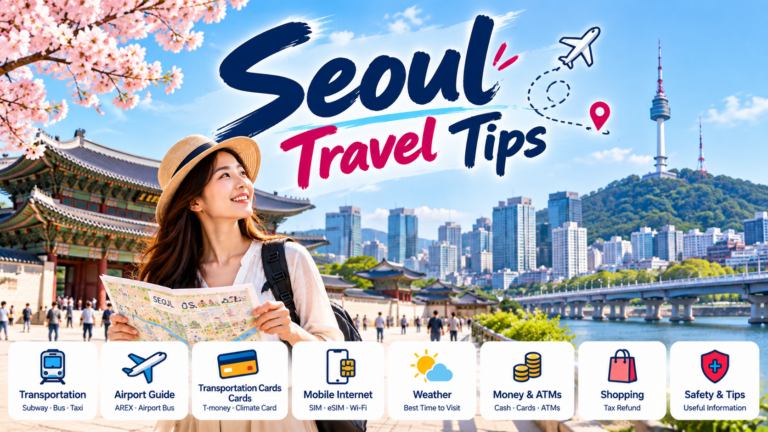
Essential Tips for First-Time Visitors to Seoul
Planning your first trip to Seoul? These simple travel tips will help you get around the city more easily, save time, and enjoy your trip with confidence.
Planning your first trip to Seoul? A little preparation can make a big difference.
Seoul is a large and busy city, but international travelers can explore it much more easily once they understand a few basics about transportation, payments, navigation, food, weather, and local customs.
This Seoul travel tips guide focuses on practical information that can help you before and during your trip. Instead of trying to plan every minute of your journey, use these tips to make everyday travel simpler, avoid common mistakes, and spend more time enjoying Seoul.
1. Getting from Incheon Airport to Seoul
Incheon International Airport is the main gateway for international visitors arriving in Korea.
After landing, you have several transportation options, including the AREX Airport Railroad, airport limousine buses, and taxis.
Your best option depends on where your hotel is located, how much luggage you have, your arrival time, and how comfortable you are with transfers.
AREX Airport Railroad
The AREX train is useful when your destination is convenient for Seoul Station or another connected subway route.
It can be a practical choice for travelers who:
- Have manageable luggage
- Prefer rail transportation
- Want to avoid road traffic
- Are comfortable transferring to the Seoul subway
Airport Limousine Bus
An airport bus can be convenient if your hotel is close to a designated bus stop.
It can be particularly useful when you have several suitcases because you do not need to carry your luggage through multiple subway stations and transfers.
Taxi or Private Transfer
A taxi or private transfer can be more convenient for families, groups, travelers with heavy luggage, or visitors arriving late.
Travel Tip: Don’t choose airport transportation based only on price. Consider the complete journey from the airport to your hotel, including walking, transfers, stairs, and luggage.
For detailed airport transportation information, see our Incheon Airport to Seoul guide.
2. Use a T-money Card
A T-money card is one of the easiest ways for visitors to use public transportation in Seoul.
It can be used on:
- Seoul Subway
- City buses
- Airport buses
- Participating taxis
- Some other transportation services
The basic system is simple:
Buy → Recharge → Tap → Travel
When using public transportation, remember to tap your card when entering and leaving the system where required.
T-money is particularly convenient if you are taking several subway and bus journeys during your trip.
How Much Money Should You Add?
Instead of putting a large amount of money on your card immediately, consider starting with a moderate balance.
You can then check your remaining balance and recharge when necessary.
This can help prevent having a large unused balance at the end of your trip.
Travel Tip: Keep some Korean won available because standard T-money purchases and recharges may require Korean cash depending on the service and location.
3. Seoul Subway Is Tourist-Friendly
The Seoul subway may look complicated when you first see the map, but it can be one of the easiest ways to move between major tourist areas.
Subway lines are identified by numbers and colors, and many station signs include Korean and English.
Before entering a subway station, check four things:
Line → Direction → Transfer → Exit
The exit number is especially important.
A large subway station can have many exits, and the correct exit can save you considerable walking time.
When Transferring
Follow the signs showing the line number and color.
Don’t simply follow the crowd. Confirm the line and direction before boarding.
If two routes require a similar number of transfers, a route with less walking inside the station may be more comfortable, particularly when carrying luggage.
Travel Tip: Use a subway route planner before leaving your hotel rather than trying to work out the entire route after entering the station.
4. Airport Bus Can Be Easier with Luggage
Travelers sometimes automatically choose the subway because it is inexpensive and convenient.
However, luggage can change the equation.
An airport limousine bus can be easier when you have:
- Two or more large suitcases
- Children
- Elderly travelers
- Heavy shopping bags
- A hotel close to a bus stop
Airport buses connect Incheon Airport with various parts of Seoul.
Travel time depends on the route and road traffic, so allow extra time during busy periods.
Travel Tip: Check the airport bus stop closest to your accommodation before leaving the airport. Knowing the stop name in advance can make your arrival much less stressful.
5. Use a Navigation App
Navigation is an important part of traveling in Seoul.
Consider using:
- Naver Map
- KakaoMap
- Google Maps
Local navigation services can be particularly useful for Korean addresses, subway routes, buses, walking directions, and restaurant locations.
When searching, use the exact name of your destination whenever possible.
Check the Walking Route
Don’t stop planning once you reach the subway station.
Your actual journey may be:
Hotel → Subway station → Train → Transfer → Destination station → Exit → Walking route
The final walking section can sometimes take longer than expected.
Travel Tip: Save your hotel name and address on your phone. If communication becomes difficult, showing the address can be much easier than trying to explain the location.
6. Carry Some Korean Won
Credit and debit cards are widely used throughout Seoul, particularly at hotels, department stores, restaurants, cafes, and larger shops.
Nevertheless, carrying some Korean won is useful.
Cash may be helpful at:
- Traditional markets
- Small restaurants
- Street food stalls
- Small local businesses
- Some transportation-related services
- T-money purchases or recharges
You don’t necessarily need to carry a large amount of cash.
A practical approach is to use your international card for most purchases while keeping some Korean won as a backup.
Using ATMs
If you need additional cash, look for ATMs that support international cards.
Before completing a withdrawal, check the ATM’s instructions carefully, including any fee and currency-conversion options.
Travel Tip: Keep your card and cash in separate places when possible. This gives you a backup if you lose your wallet.
7. Taxis in Seoul
Taxis can be useful when a destination is inconvenient to reach by subway or when you have heavy luggage.
They can also be convenient after a long day of sightseeing.
Before getting into a taxi, make sure you know your destination.
Instead of trying to pronounce a complicated Korean address, you can show the driver:
Destination name + Korean address
A navigation app can also help you confirm that you are heading toward the correct location.
When Is a Taxi Useful?
A taxi can be particularly convenient when:
- You have heavy luggage
- You are traveling with children
- Your destination is far from a subway station
- You are traveling as a small group
- You are returning to your hotel late in the day
Travel Tip: Check your destination on your phone before entering the taxi and keep the hotel address saved for the return journey.
8. Korean Restaurant Tips
Food is one of the most enjoyable parts of traveling in Seoul.
Korean restaurants range from traditional markets and small neighborhood restaurants to modern restaurants and large food halls.
Many Korean meals are designed to be shared.
Common foods to try include:
- Korean BBQ
- Bibimbap
- Bulgogi
- Kimchi
- Tteokbokki
- Kimbap
- Korean fried chicken
- Kimchi jjigae
- Naengmyeon
- Korean street food
Side dishes called banchan are commonly served with many Korean meals.
Ordering Food
If you are unsure what to order, photographs, English menus, translation apps, or simple Korean food names can help.
Don’t feel that you need to order a huge amount of food at once. You can start with one or two dishes and order more if necessary.
Travel Tip: Save the name and address of a restaurant on your phone before visiting, especially if it is located inside a busy market or shopping district.
9. Korean Etiquette
Understanding a few basic customs can make your experience more comfortable.
Remember to:
- Keep your voice relatively quiet on public transportation.
- Give priority seats to people who need them.
- Avoid blocking subway doors.
- Stand to one side when waiting for passengers to exit.
- Remove your shoes where required.
- Be respectful when visiting temples and historic sites.
- Follow signs and staff instructions.
- Avoid blocking narrow walkways while taking photographs.
- Remember that tipping is generally not expected in Korea.
Public Transportation Etiquette
Seoul’s subway and buses can become crowded, particularly during busy periods.
Allow passengers to get off before entering.
When standing inside a subway car, avoid placing large bags where they block other passengers.
Travel Tip: A little awareness of local customs can make public transportation and sightseeing much more comfortable for everyone.
10. Weather & What to Wear
Seoul has four distinct seasons, and the weather can change considerably throughout the year.
Spring
Spring is generally associated with milder temperatures and flowers.
Light layers can be useful because temperatures may change between morning and evening.
Summer
Summer can be hot and humid, with periods of heavy rain.
Light clothing, comfortable shoes, sunscreen, and rain protection can be useful.
Autumn
Autumn often brings cooler temperatures and colorful foliage.
Layering is useful because mornings and evenings can feel considerably cooler than the afternoon.
Winter
Winter can be cold and dry, and temperatures can fall significantly.
Warm outerwear, gloves, and suitable footwear can make outdoor sightseeing more comfortable.
Travel Tip: Check the weather before leaving your hotel each morning rather than relying only on the forecast you checked before your trip.
For detailed seasonal information, see our Seoul Weather guide.
11. Tax Refund for Foreign Visitors
Eligible foreign visitors may be able to receive a tax refund when shopping at participating stores.
Look for stores displaying a Tax Free or tax-refund sign.
Keep:
- Your passport
- Receipts
- Tax-refund documents
- Purchased items when required for verification
The refund process can differ depending on whether the store offers an immediate refund or another refund method.
Travel Tip: Don’t throw away receipts immediately after shopping. Keep them until you have completed the relevant refund process.
For detailed procedures, see our Shopping & Tax Refund guide.
12. What to Do in an Emergency
Knowing a few important emergency numbers before traveling can provide peace of mind.
Police
112
Medical Emergency / Ambulance
119
For tourist assistance, international visitors can also use the 1330 Tourist Information Center service.
Keep important information on your phone, including:
- Hotel name
- Hotel address
- Passport information
- Travel insurance details
- Emergency contacts
- Embassy or consulate contact information
If you have a serious problem, don’t rely only on a translation app. Ask hotel staff, police officers, medical staff, or another appropriate official for assistance.
13. Keep Your Phone Ready for Travel
Your smartphone will probably become one of your most useful travel tools in Seoul.
Before leaving your hotel each morning, check:
- Battery level
- Mobile data
- Navigation app
- Hotel address
- Destination address
- Transportation route
- Weather
- Important reservations
A portable battery can be especially useful on sightseeing days.
You may spend many hours outside while using navigation, taking photographs, translating text, checking restaurant information, and looking up subway routes.
Travel Tip: Save important information offline or as screenshots when possible. This can help if your mobile connection becomes temporarily unavailable.
14. Don’t Plan Too Many Places in One Day
One of the most common mistakes first-time visitors make is trying to visit too many attractions.
Seoul is large, and two attractions that appear close on a map may require significant walking or transportation time.
Instead of counting attractions, think in terms of neighborhoods.
For example:
Gyeongbokgung → Bukchon → Insadong → Ikseon-dong
can create a more practical sightseeing day than traveling repeatedly across the city.
Similarly:
Hongdae → Yeonnam-dong → Mangwon
can be organized into another neighborhood-focused day.
Leave Some Free Time
Allow time for:
- Lunch
- Coffee
- Shopping
- Photography
- Rest
- Unexpected discoveries
A flexible itinerary is often easier to enjoy than a schedule packed from morning until night.
15. Check Opening Hours Before You Visit
Before traveling to a major attraction, museum, palace, market, or restaurant, check its current opening information.
Opening hours may vary by:
- Day of the week
- Public holiday
- Seasonal schedule
- Special event
- Maintenance
- Temporary closure
This is particularly important when your itinerary depends on visiting one specific attraction.
Travel Tip: Check opening information on the day before your visit and again on the morning of the trip when the attraction is especially important to your schedule.
16. Wear Comfortable Shoes
This sounds simple, but it is one of the most useful Seoul travel tips.
Even when you use public transportation, a sightseeing day can involve a surprising amount of walking.
You may walk:
- Through subway stations
- Between subway exits
- Along shopping streets
- Through traditional neighborhoods
- Around palace grounds
- Through markets
- Along the Han River
- Between restaurants and attractions
Comfortable shoes can make a major difference.
If you plan to visit areas such as Bukchon or Namsan, also consider slopes, stairs, and uneven surfaces when planning your day.
Quick Tips for Your Seoul Trip
Before You Leave Your Hotel
✓ Check the weather
✓ Charge your phone
✓ Bring your T-money card
✓ Check your transportation route
✓ Check the subway exit
✓ Save your hotel address
✓ Carry some Korean won
✓ Check attraction opening hours
✓ Bring a portable battery
✓ Take comfortable shoes
When Traveling Around Seoul
✓ Follow English signs
✓ Check the subway line color
✓ Confirm the direction before boarding
✓ Check your transfer station
✓ Watch for your stop
✓ Tap your transportation card correctly
✓ Keep your belongings with you
✓ Allow extra walking time
✓ Don’t block subway doors
For Eating and Shopping
✓ Keep receipts
✓ Carry a payment backup
✓ Try traditional Korean food
✓ Explore local markets
✓ Check restaurant locations before walking there
✓ Keep tax-refund documents if applicable
A Simple Seoul Travel Formula
You don’t need to memorize everything before visiting Seoul.
A simple formula can make your trip easier:
Destination → Transportation → Station → Exit → Walking Route
And when choosing transportation:
Destination + Luggage + Travelers + Time + Budget = Your Travel Option
For daily planning:
Nearby Attractions + Food + Rest + Free Time = A More Comfortable Seoul Day
The goal isn’t to visit the maximum number of places. The goal is to create a day that is realistic and enjoyable.
Most Important Tip: Leave Some Flexibility
Seoul has an enormous amount to see, from historic palaces and traditional neighborhoods to modern shopping districts, markets, museums, cafes, K-Culture locations, and riverside parks.
You don’t have to experience everything on your first trip.
Choose several places that are important to you, group nearby destinations together, and leave some time for meals, rest, shopping, and unexpected discoveries.
If the weather changes, adjust your plan.
If a restaurant looks interesting, stop for a meal.
If you discover a neighborhood you enjoy, spend a little more time there.
A good Seoul itinerary should help you explore the city—not make you feel like you are racing from one attraction to another.
Travel Smart. Travel Easy. Enjoy Seoul.
Seoul becomes much easier to explore once you understand a few practical basics.
Use the subway strategically, check your station exit, keep more than one payment option, prepare your phone for navigation, wear comfortable shoes, and give yourself enough time between destinations.
Use these Seoul travel tips together with our transportation guides, attraction guides, food guides, itineraries, and travel tools to build a Seoul trip that fits your own travel style.
Travel smart. Explore at your own pace. Enjoy Seoul.