
Ikseon-dong: A Guide to Seoul’s Hanok Alleys
Ikseon-dong is one of the most interesting neighborhoods to explore in central Seoul if you want to see how traditional Korean architecture and modern city life exist side by side. The area is located in Jongno-gu, close to Jongmyo Shrine, Insadong, and Changdeokgung Palace.
What makes Ikseon-dong different from a typical historic attraction is the way you experience it. There is no single building or monument that you need to see. Instead, the neighborhood is made up of small lanes, traditional hanok houses, restaurants, cafés, dessert shops, boutiques, and other businesses packed into a relatively compact area.
For first-time visitors to Seoul, Ikseon-dong can therefore work especially well as part of a walking itinerary rather than as a destination that requires an entire day.
What Makes Ikseon-dong Special?
Ikseon-dong developed as a residential area filled with small hanok houses. Seoul’s Hanok Portal states that 118 hanok houses built before the 1930s remain in the neighborhood, and the area was designated as a hanok concentrated area in 2018.
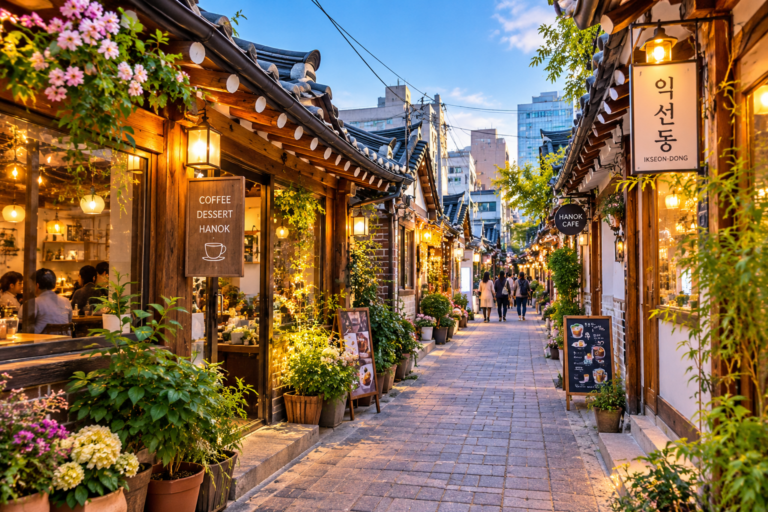
Today, many of these small buildings have been adapted for contemporary businesses. A traditional wooden structure might contain a coffee shop, while another may house a Korean restaurant, bakery, clothing store, or small boutique.
This creates an unusual visual contrast.
You can walk past a traditional tiled roof and wooden doorway, then turn the corner and find a modern café or stylish restaurant. The buildings themselves may look historic, while the businesses operating inside them are designed for today’s customers.
That combination is one of the main reasons Ikseon-dong has become popular with both Korean visitors and international travelers.
Walking Through the Narrow Alleys
The best way to experience Ikseon-dong is on foot.
The lanes are much narrower than the streets found in most modern parts of Seoul. Some passages can become busy, particularly during popular dining and café hours, so visitors should expect to walk slowly rather than treat the area like a normal shopping street.
Instead of trying to follow a fixed list of shops, take some time to explore the smaller side streets. You may find that the atmosphere changes from one alley to another.
For travelers who enjoy photography, the combination of tiled roofs, wooden doors, small courtyards, signs, plants, and narrow passageways provides plenty of interesting details.
Because the neighborhood is compact, you do not need to walk very far to see a different section of Ikseon-dong.
Cafés and Korean Food
Food is an important part of the Ikseon-dong experience.
The neighborhood contains a mixture of Korean restaurants, cafés, bakeries, dessert shops, and contemporary food businesses. Some restaurants use the traditional character of the hanok as part of the dining environment, while others have created much more modern interiors.
This makes Ikseon-dong a useful place to include a meal or café stop during a Jongno sightseeing day.
However, it is worth remembering that Ikseon-dong is a popular area. A restaurant or café that looks quiet from outside may already have limited seating inside.
If you are traveling with a group, checking the restaurant’s current operating information or reservation policy before visiting can save time.
Ikseon-dong for First-Time Visitors
If this is your first visit, you do not need to plan a complicated route.
A simple visit can take around 1–2 hours, depending on whether you stop for food or coffee.
One practical approach is:
Jongno 3-ga Station → Ikseon-dong alleys → café or Korean meal → Jongmyo Shrine or Insadong
This makes Ikseon-dong easy to combine with other attractions in central Seoul.
Jongno 3-ga Station is served by Subway Lines 1, 3, and 5, giving visitors several convenient ways to reach the neighborhood. Seoul’s official tourism information lists Exit 4 as one of the closest access points.
Because Ikseon-dong is located in central Jongno, it is also possible to continue walking toward other historic areas after exploring the hanok neighborhood.
A Good Walking Combination
One of the advantages of Ikseon-dong is its location.
Rather than visiting it as an isolated attraction, you can connect several destinations into one walking day.
For example:
Changdeokgung Palace → Ikseon-dong → Jongmyo Shrine → Insadong
Another option is:
Gyeongbokgung Palace → Insadong → Ikseon-dong → Jongno 3-ga
The exact route depends on your interests and how much walking you want to do.
Seoul’s own walking-tour information also places Ikseon-dong within a broader Jongno walking route that includes Donhwamun-ro, Changdeokgung Palace, Seosulla-gil, and Jongmyo Shrine.
When Should You Visit Ikseon-dong?
There is no single perfect time for everyone.
Morning can be suitable if you prefer a quieter walk and want to concentrate on the architecture and streets.
Afternoon is convenient if you want to combine sightseeing with cafés, desserts, or shopping.
Evening offers a different atmosphere as restaurants and cafés become more active and the traditional buildings are illuminated.
If photography is your priority, visiting before the busiest period can make it easier to walk through the narrow alleys without large crowds.
Weekends and holidays can be considerably busier, so travelers looking for a more relaxed experience may prefer a weekday.
Photography Tips
Ikseon-dong is more about small details than large panoramic views.
Look for:
- Traditional tiled roofs
- Wooden doors and windows
- Small hanok courtyards
- Narrow alleyways
- Traditional architectural details
- Modern signs against old buildings
- Cafés inside renovated hanok houses
- Street scenes showing the contrast between old and new Seoul
Try photographing the street from a respectful distance rather than blocking narrow passageways.
Also remember that Ikseon-dong is a living neighborhood and commercial district, not an open-air museum. Some buildings are businesses or private properties, so visitors should avoid entering restricted areas simply because a doorway looks interesting.
Ikseon-dong vs. Bukchon Hanok Village
Travelers sometimes wonder whether they should visit Ikseon-dong or Bukchon.
They offer different experiences.
Bukchon is better suited to travelers who want to see a larger traditional residential neighborhood and historic hanok streets.
Ikseon-dong is more compact and strongly connected with cafés, restaurants, shopping, and contemporary Seoul culture.
If you have enough time, visiting both can actually give you a better understanding of how Seoul’s traditional neighborhoods have developed in different ways.
Nearby Attractions
Ikseon-dong is surrounded by several major attractions, making it easy to include in a larger Seoul itinerary.
Jongmyo Shrine
Jongmyo Shrine is located nearby and provides a very different experience from the lively streets of Ikseon-dong. It is associated with the royal rituals of the Joseon Dynasty.
Changdeokgung Palace
Changdeokgung is another nearby historic attraction and can be combined with Ikseon-dong for a day focused on Seoul’s traditional architecture and royal history.
Insadong
Insadong is within walking distance and is known for traditional arts, crafts, souvenirs, tea houses, galleries, and shopping.
This combination gives travelers an easy way to experience several different sides of Jongno without relying heavily on transportation.
Useful Tips Before You Go
Ikseon-dong is easy to visit, but a few things can make the experience more comfortable.
Wear comfortable shoes. The neighborhood is best explored on foot, and you may continue walking to nearby attractions.
Expect narrow streets. Some lanes become crowded, so allow extra time when moving between locations.
Check business hours. Individual cafés, restaurants, and shops have their own schedules and may change operating hours.
Do not plan every minute. Part of Ikseon-dong’s appeal is discovering small streets and businesses while walking.
Be respectful when taking photographs. Avoid photographing people closely without permission and do not obstruct entrances or narrow walkways.
How Long Should You Spend in Ikseon-dong?
For a quick visit, 60–90 minutes is enough to walk through the main area and take photographs.
If you want to have coffee, eat a meal, browse shops, and explore several side streets, allow 2–3 hours.
Most travelers do not need to dedicate an entire day to Ikseon-dong. Its location makes it more useful as one part of a Jongno walking itinerary.
Final Thoughts
Ikseon-dong is a good example of the different layers of Seoul.
The neighborhood does not preserve the past by keeping everything unchanged. Instead, older hanok buildings have become part of a modern commercial district, creating a setting where traditional architecture, Korean food, cafés, shopping, and everyday city life meet.
For international visitors, the biggest advantage is its location. A relatively short visit can easily be combined with Insadong, Jongmyo Shrine, Changdeokgung Palace, or other central Seoul attractions.
Rather than simply checking Ikseon-dong off your sightseeing list, give yourself some time to walk without a strict destination. The small alleys and changing scenery are the main reason to come here.
Quick Information
Location: Jongno-gu, Seoul
Nearest Subway: Jongno 3-ga Station, Lines 1, 3, and 5
Recommended Visit: 1–3 hours
Best For: Walking, cafés, Korean food, photography, shopping, traditional architecture
Nearby: Insadong, Jongmyo Shrine, Changdeokgung Palace
Admission: No general admission fee for walking through the neighborhood
Tip: Individual businesses may have separate opening hours, prices, and reservation policies.
The Atmosphere Changes Throughout the Day
Ikseon-dong can feel quite different depending on when you arrive. During the daytime, the narrow alleys are useful for looking at the architecture and taking photographs. As the afternoon continues, cafés and restaurants become more active, and the neighborhood gradually takes on a livelier atmosphere.
In the evening, the small streets can feel particularly atmospheric because of the warm lighting coming from restaurants and cafés. However, this is also when some of the narrowest lanes become busy.
If you want to experience both sides of Ikseon-dong, arriving in the late afternoon is a practical option. You can explore the alleys while there is still daylight, stop for coffee or dessert, and then continue walking after sunset.
🧭 Useful Seoul Travel Tools
Make your visit easier with our free travel tools.