
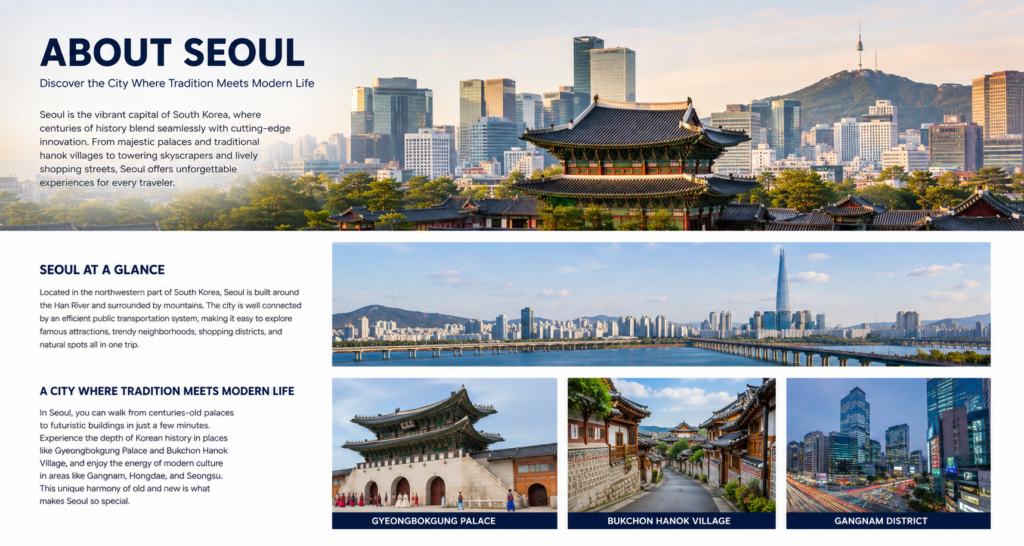
About Seoul: A Quick Introduction for First-Time Visitors
Seoul is the capital of South Korea and one of the biggest cities in Asia — a place where 600-year-old palaces sit a few minutes’ walk from glass towers, and where you can eat at a century-old market at lunch and watch K-pop dancers on the street at night. This page gives you the basics: the key facts, a little history, how the city is laid out, and where to go next.
Seoul at a Glance
| Population | More than 9 million in the city; about 26 million in the wider capital area |
| Area | About 605 km², divided into 25 districts (gu) |
| Capital since | 1394, when the Joseon Dynasty made it its capital |
| River | The Han River (Hangang) divides the city into north and south |
| Language | Korean; English signs on the subway and at major sights |
| Currency | Korean won (₩) |
| Time zone | UTC+9 |
| Climate | Four distinct seasons: hot, rainy summers and cold, dry winters |
A Short History
- 1394 — King Taejo of the Joseon Dynasty moves the capital to Hanyang (today’s Seoul) and builds Gyeongbokgung Palace. A city wall with eight gates, including Heunginjimun (Dongdaemun), surrounds the capital.
- 1592–1598 — Japanese invasions burn the palaces. Changdeokgung is rebuilt first and serves as the main palace for about 250 years.
- 1910–1945 — Japanese colonial rule; the city is called Keijo.
- 1950–1953 — The Korean War leaves much of Seoul in ruins.
- 1960s–1990s — Rapid industrial growth, often called the “Miracle on the Han River.” Gangnam develops south of the river; the 1988 Summer Olympics are held in Seoul.
- Today — A global center for technology, design, food and K-culture, with historic sites restored alongside some of the most modern infrastructure in the world.
How the City Is Laid Out
Think of Seoul in a few big zones:
| Zone | Character | Our guides |
|---|---|---|
| Old city center (north of the river) | Palaces, hanok neighborhoods, markets, government district | Jongno, Bukchon, Myeongdong, Dongdaemun |
| Namsan and Yongsan | The mountain with N Seoul Tower, international neighborhoods, museums | N Seoul Tower, Itaewon |
| West | University districts, youth culture, local markets | Hongdae |
| East | Converted factories, cafes, Seoul Forest | Seongsu-dong |
| South of the river | Modern business and shopping districts | Gangnam, COEX |
| The river itself | Parks, cycling paths, picnics and night views | Han River parks |
Mountains ring the city — Bugaksan behind the palaces, Namsan in the middle and Bukhansan to the north — so you’re never far from a hiking trail or a viewpoint.
What Seoul Is Best For
- History and architecture — five royal palaces, Jongmyo Shrine and hanok villages.
- Food — from ₩3,000 gimbap to Korean BBQ and Michelin-listed restaurants. → Korean food guide
- Shopping — K-beauty, fashion and late-night markets. → Shopping in Seoul
- Easy, cheap transport — most subway rides cost ₩1,550. → Seoul subway guide
- Safety — Seoul is one of the safer large cities for visitors, including at night.
When to Visit
Spring (April–May) and autumn (late September–November) are the most comfortable. Summer is hot and rainy; winter is cold but clear. → Seoul weather by month
Plan Your Trip
- Read the basics: travel tips for first-time visitors
- Choose where to stay: best areas compared
- Pick an itinerary: 3 days · 5 days · 7 days
- Sort out the essentials: Travel information
Figures are approximate and rounded for easy reading.